
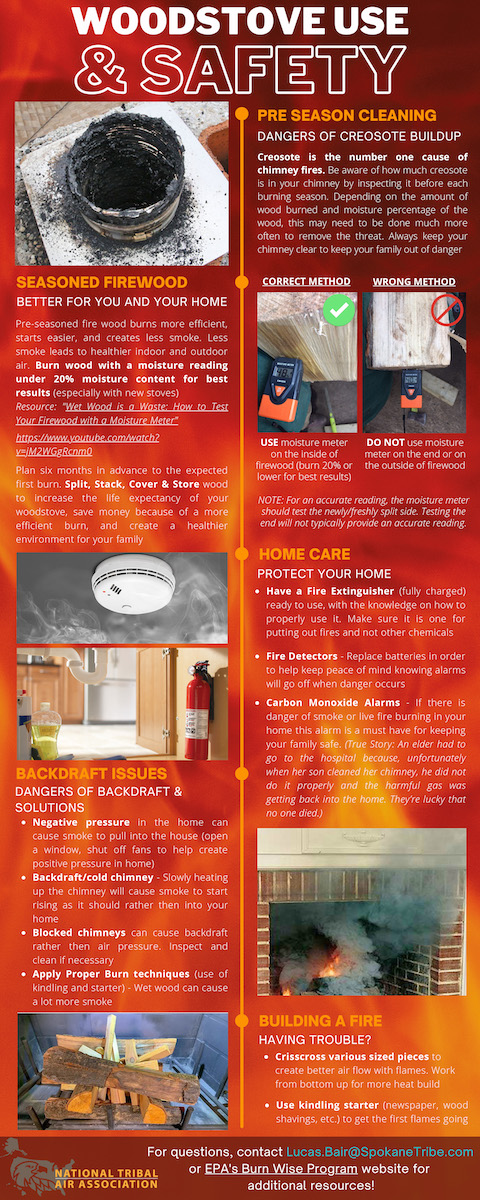
Many Tribal homes use old, inefficient and dirty burning stoves for heating and cooking. These outdated stoves may also release wood smoke that is harmful to the health of residents, especially the young and the old. To avoid these health risks and to gain the greater efficiency and effectiveness of new, cleaner burning technology wood stoves, it is recommended that old stoves be gradually replaced or “changed out.”
For more information and resources about wood smoke and stove change outs see our Indoor Air Quality page.

 Loading…
Wildfire smoke is not just a nuisance but can be toxic if inhaled for long periods of time. Although wildfire is necessary for a lot of forest ecosystems, the smoke can still be damaging to a person’s respiratory and overall health. Wildfire smoke inhalation can lead to a range of health issues, particularly for those with pre-existing respiratory or cardiovascular conditions. The smoke contains harmful chemicals such as carbon monoxide, aldehydes, and particulate matter, which can cause symptoms like cough, shortness of breath, headaches, and increased heart rate. In severe cases, it can lead to life-threatening complications such as heart attacks and strokes.
To avoid these health effects, it is important to stay informed about air quality alerts and take precautions to limit exposure during wildfire events. EPA has information on a “Do-It-Yourself (DIY) Air Cleaner to Reduce Wildfire Smoke Indoors: Basic Design.”

January 2026 – the work group heard from Red Feather, a Flagstaff-based nonprofit that repairs and weatherizes homes on the Navajo Nation and Hopi. The non-profit also performs woodstove replacements and educates homeowners on the proper maintenance of woodstoves.
April 2025 – In April 2025, the Wildfire/Wood Smoke Working Group had a presentation from the EPA on the AirNow tool and its use for wildfire smoke events and air quality. The link to the recording is available on our “Webinars” page under “Resources.”
NTAA’s Baseline Needs Assessment – The workgroup presented wood smoke-related data from NTAA’s Baseline Needs Assessment. The presentation can be downloaded as a PDF. Highlighted from the BNA, wood smoke is one of the top 4 most concerning issues in terms of air quality in Indian Country. Contact Marty.Johnson@nau.edu if you have any questions regarding this presentation.
National Tribal Air Association’s White Paper on the Wood Heater Emission Pilot Project for Indian Country – Written by NTAA Policy Advisory Committee Member, Laura McKelvey. This White Paper details Wood Stove changeout programs and its effectiveness to help improve indoor air quality for the many Tribal citizens who rely on woodstoves as a primary or secondary heat source. NTAA supports these changeout programs and urges the EPA to meet the 1988 EPA Clean Air Act emission standards, much less the current emissions standards implemented in 2015.
Wood Stove Operation and Maintenance – ITEP hosted a webinar series for training Tribes on wood-stove operation and maintenance. You can view the recorded webinar series here.
Intro To Residential Wood Heating, Health Effects, Particle Pollution and More
WOOD SMOKE RESOURCES
Indoor Air Quality Wood Smoke (EPA)
Burn Wise (EPA’s Burn Wise program has been sunsetted, but the resources are still available)
Changeout Campaigns Case Studies (EPA)
Woodsmoke and Smoke Events (Tribal Healthy Homes Network)
State Policies and Change-out Programs (Alliance for Green Heat)
Red Feather’s Online Education and Resources
WILDFIRE SMOKE RESOURCES
AirNow Fire and Smoke Map
Wildland Fires and Smoke (EPA)
Guide to Air Cleaners in the Home (EPA)
EPA’s Do-It-Yourself Air Cleaners
In 1992, Congress passed the Indian Environmental General Assistance Program Act. This act authorized EPA to provide General Assistance Program (GAP) grants to federally recognized tribes and tribal consortia for planning, developing and establishing environmental protection programs in Indian country, and for developing and implementing solid and hazardous waste programs on tribal lands.
The U.S. Forest Service invests in local wood economies through its grant programs. These grants support innovation, expand wood energy markets, and promote wood as a sustainable building material. The three programs offered are the Wood Innovations Grant, Community Wood Grant, and the Wood Products Infrastructure Assistance Grant.
This grant enables programs to acquire more wood and larger processing equipment.

 Reload document
  Open in new tab